
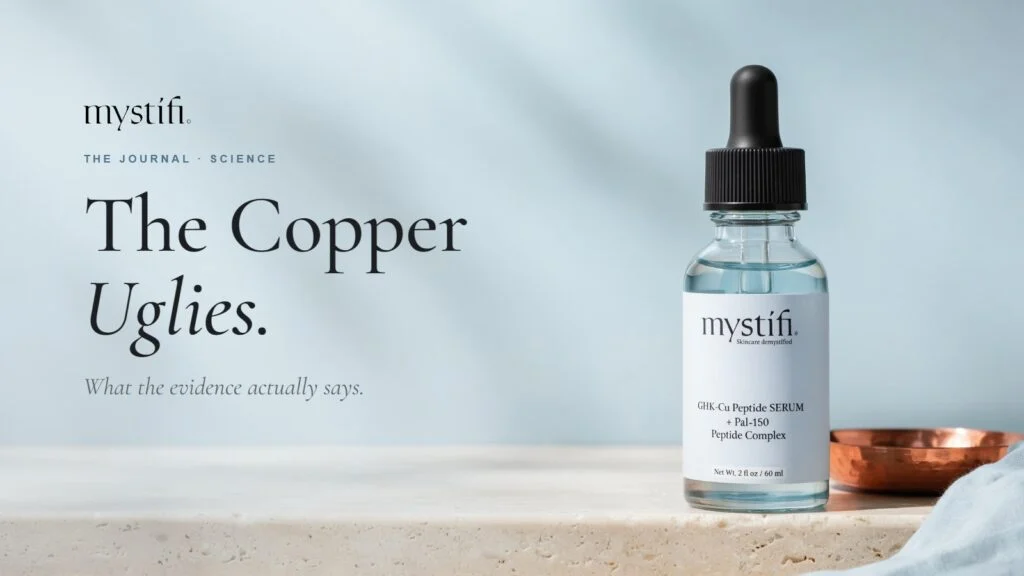
Read about copper peptides for long enough and you will meet the “copper uglies”: people who say their skin looked worse after starting one. Drier, duller, more lined, sometimes broken out. We sell a copper peptide serum, so we would rather you read about it here than wonder why we left it out.
It is a forum term, not a diagnosis, and we could not find a published study of it. That does not make every report wrong. Here is what is known, what is not, and how to start a copper peptide carefully.
The short answer
- “Copper uglies” is an informal name for skin that looks worse after starting a copper peptide. It has no medical definition, and a search of PubMed for the term returns nothing.
- The reactions in the studies we read are ordinary ones: irritation in a small number of people and, rarely, an allergy to copper.
- The popular explanation is a theory. The idea that the peptide breaks collagen down faster than skin rebuilds it has not been shown in people, and the lab data we read do not support it.
- Strength matters. The safety review most often quoted looked at far lower concentrations than a 1% serum, so start slowly.
Where the term comes from
“The uglies” was already in use in 2012 on the customer forum of Skin Biology, the skincare company of Loren Pickart, the biochemist who first isolated GHK-Cu. One customer asked how to tell whether the uglies meant old damage coming to the surface or a sign of overuse.
A year later another asked whether overusing copper peptides could damage collagen. Pickart replied that he had never seen that happen in clinical studies, and that irritation did occur at concentrations higher than his products used. Bear in mind that he was selling them.
The term has since spread through Reddit and TikTok. In a 2026 article in The Nod, one dermatologist described it as an internet term, not a recognised condition, covering dryness, redness, breakouts or skin that looks more lined for a while. Another made a point worth remembering: dehydrated, irritated skin can look much more wrinkled without having lost any collagen.
What the research records
The best-controlled trial of a GHK-Cu serum is Badenhorst et al., 2016: 40 women aged 40 to 65, applying a different product to each side of the face twice a day for 8 weeks. The products were well tolerated by 39 of the 40. One participant had minor skin reactions on both sides of the face, stopped, and the symptoms cleared without treatment. The authors add that, apart from that one reaction, nobody had the peeling, dryness or redness that are common with tretinoin.
Two cautions. The study was funded by the company that made the serum, and the paper does not give the serum’s GHK-Cu percentage. It tells you how that formula behaved, not how every copper peptide product will.
In the lab, Li and colleagues exposed skin cells to GHK-Cu and to two plain copper salts at the same concentrations. The copper salts switched on markers of irritation. GHK-Cu did not, and it did not harm the cells. That is cells in a dish, not faces, but it suggests copper bound to the peptide behaves differently from loose copper.
True copper allergy exists but is uncommon. A 2014 review of the evidence concluded that copper is a very weak sensitiser compared with other metals, while noting that a few people do have real reactions.
The collagen breakdown theory
The explanation you will read most often goes like this. GHK-Cu does not only build. A 2015 review of the research describes it as stimulating both the making and the breaking down of collagen, and as regulating the enzymes that break collagen down along with their inhibitors. That is remodelling: clearing damaged protein and laying down new. Use too much, the theory says, and the clearing outruns the rebuilding.
It is a reasonable guess, but the lab data do not show it. In the Badenhorst team’s cell work, gene activity for the breakdown enzymes rose only at the lowest dose tested. An inhibitor of those enzymes rose at every dose, and by more than the collagen-cutting enzyme did. At higher doses the enzymes barely moved. The picture is not perfectly tidy: a second inhibitor fell at the higher doses, which the authors did not read as a shift towards breakdown.
Nobody has measured any of this in the skin of people who report the uglies. A dermatologist quoted in The Nod called the theory plausible but not proven. The same article’s dermatologists reach first for simpler causes: irritation, a disturbed skin barrier, another ingredient in the formula such as fragrance or a preservative, or a routine that stacks a copper peptide on top of acids and retinoids.
What the safety review does and does not cover
The Cosmetic Ingredient Review, the US expert panel that assesses the safety of cosmetic ingredients, reviewed Copper Tripeptide-1 in 2014 and concluded it is safe as used. That line is quoted a lot. The detail matters more.
The panel based its conclusion on low use concentrations: typically under 10 parts per million, which is 0.001%, with a highest reported figure of 0.002% for any peptide in the group. No concentration was reported for Copper Tripeptide-1 itself, and the skin tests the panel reviewed were on related peptides, not the copper one.
A serum that states 1%, ours included, sits far above that range. That does not make a 1% serum unsafe. It means the review does not settle the question, and that the sensible way to begin is slowly.
How to start a copper peptide serum
- Patch test first. A little behind the ear or on the inner arm, then wait 24 hours.
- Build up. If your skin is sensitive or your routine is already busy, use it once a day for the first two weeks before moving to morning and night.
- Use the amount on the label. More is not better. We explain why in How much GHK-Cu should a serum contain?
- Keep strong acids apart. Leave L-ascorbic acid and glycolic acid out of the same routine, and put retinol at a different time of day. More in GHK-Cu vs retinol.
- Keep the rest simple. A gentle cleanser, a moisturiser and sunscreen. Add other actives back one at a time.
- Not on broken or irritated skin. Wait until it has settled.
If your skin looks worse
Stop the new product. Stinging is not a sign that something is working. Go back to cleanser, moisturiser and sunscreen until your skin has settled. If you want to try again, patch test, then use it less often than before.
See a doctor or dermatologist for swelling, blistering, a rash that spreads, or anything that does not settle after you stop.
Where our serum fits
Our GHK-Cu serum states its concentration, 1%, alongside Pal-150, and it is fragrance-free. We will not tell you it cannot irritate. Any active can, and we have not yet run a study of our own formula.
What we can do is tell you what is in the bottle, so you can start it the way this article suggests. Every study we cite is on The studies, with links to the sources.
Common questions
Are the copper uglies real?
The reports are real, but the name is informal and no published study describes it. Dermatologists who have commented put most cases down to irritation or dryness. The collagen breakdown explanation is unproven.
Are the copper uglies permanent?
We found no published follow-up, so nobody can give you a figure. In the one reaction reported in the trial above, the symptoms cleared after the participant stopped, without treatment.
Do copper peptides cause purging?
There is no good evidence for a purge. If breakouts or irritation appear, treat them as a reaction and stop, not as a phase to push through.
What are the side effects of GHK-Cu on skin?
In the studies we read of products applied to skin: irritation in a small minority, and copper allergy, which is rare. This article is about skincare. Injected GHK-Cu is a different subject, and we do not cover it.
Sources
- Badenhorst T., Svirskis D., Merrilees M., Bolke L., Wu Z. Effects of GHK-Cu on MMP and TIMP Expression, Collagen and Elastin Production, and Facial Wrinkle Parameters. Journal of Aging Science, 2016.
- Li H., Toh P.Z., Tan J.Y. et al. Selected Biomarkers Revealed Potential Skin Toxicity Caused by Certain Copper Compounds. Scientific Reports, 2016.
- Fage S.W., Faurschou A., Thyssen J.P. Copper hypersensitivity. Contact Dermatitis, 2014.
- Pickart L., Vasquez-Soltero J.M., Margolina A. GHK Peptide as a Natural Modulator of Multiple Cellular Pathways in Skin Regeneration. BioMed Research International, 2015.
- Cosmetic Ingredient Review Expert Panel. Safety Assessment of Tripeptide-1, Hexapeptide-12, their Metal Salts and Fatty Acyl Derivatives, and Palmitoyl Tetrapeptide-7 as Used in Cosmetics. Final report, 30 June 2014.
- Skin Biology customer forum: Moving Up To Stronger CPs, July 2012, and Overusing damage, December 2013.
- Anthony P. Copper peptides: holy grail or a fast track to ageing skin? The Nod, 3 October 2026.
These are published studies of the ingredient and of other brands’ formulas, not studies of Mystifi’s formula. This article is general information, not medical advice.