
Nobody has shown what the best GHK-Cu percentage is. Search the question and you will find answers from 0.01% to 3%, usually with no study attached. We went to the papers instead. The human studies quoted most often do not state the concentration of the products they tested, and we could not find a trial that compares one percentage against another.
So be careful with any page that names a perfect number. What you can do is choose a serum that tells you its concentration, then read the rest of the label properly. Here is what the research does and does not say.
What the human studies say about GHK-Cu concentration
GHK-Cu is a copper-bound tripeptide, first identified in 1973. Two review papers pull the skin research together (Pickart and Margolina, 2018; Pickart et al., 2015). They describe a facial cream tested on 71 women and an eye cream tested on 41 women, each for 12 weeks. Neither review says how much GHK-Cu those creams contained.
The best-known controlled trial is Badenhorst et al., 2016: randomised and double-blind, with 40 women aged 40 to 65 applying a different product to each side of the face, twice a day for 8 weeks. Compared with a product containing Matrixyl 3000, the GHK-Cu serum reduced wrinkle volume by 31.6%. Compared with a control serum, the figure was 55.8%. Against Matrixyl 3000, the difference in wrinkle depth was not statistically significant.
We read the full paper, and it does not give that serum’s GHK-Cu percentage either. It was funded by the company that made the serum, which the authors say played no part in the data, the analysis or the writing. And the result belongs to that formula, which carried GHK-Cu in a lipid nano-carrier. It cannot be moved across to another serum, ours included.
Why a higher percentage is not automatically better
Lab work on skin cells uses tiny doses: the Badenhorst team tested 0.01, 1 and 100 nanomolar. Their paper notes earlier work in which the cells’ response peaked at 1 nanomolar and fell at higher levels. In their own cells, raising the concentration did not significantly increase the response.
That is cells in a dish, with no skin barrier in the way, so it does not tell you what to look for on a bottle. It does show that “more is better” is an assumption, not a finding.
Why the formula matters as much as the number
GHK-Cu loves water, and the outer layer of skin does not. Researchers read this differently. The 2018 review says it may be possible to pass an adequate amount through the skin easily. The Badenhorst team call delivery “challenging” and built a nano-carrier to help.
One lab study gives a concrete figure. Hostynek and colleagues applied a 0.68% solution, a figure the paper reports in terms of copper, to donated human skin samples and measured the copper moving through over 48 hours. It did get through. But that measures movement in a lab, not how skin looks, and it does not make 0.68% a target.
The practical point: two serums with the same percentage are not the same product. The percentage tells you how much is in the bottle, not what the rest of the formula does with it.
How to read a copper peptide label
- Find the ingredient. GHK-Cu appears in an ingredient list as Copper Tripeptide-1.
- Look for a stated percentage. US cosmetic labels need an ingredient list, not percentages, so check the product page too. If you cannot find a number, ask the brand.
- Do not guess from its place in the list. Under US labeling rules, ingredients above 1% run in descending order, but anything at 1% or less can follow in any order. Below that line, position tells you nothing about the amount.
- Ask what a quoted study actually tested. Research on the ingredient is not research on that bottle. If a brand quotes a number, check whether it comes from its own formula.
What 1% means in our serum
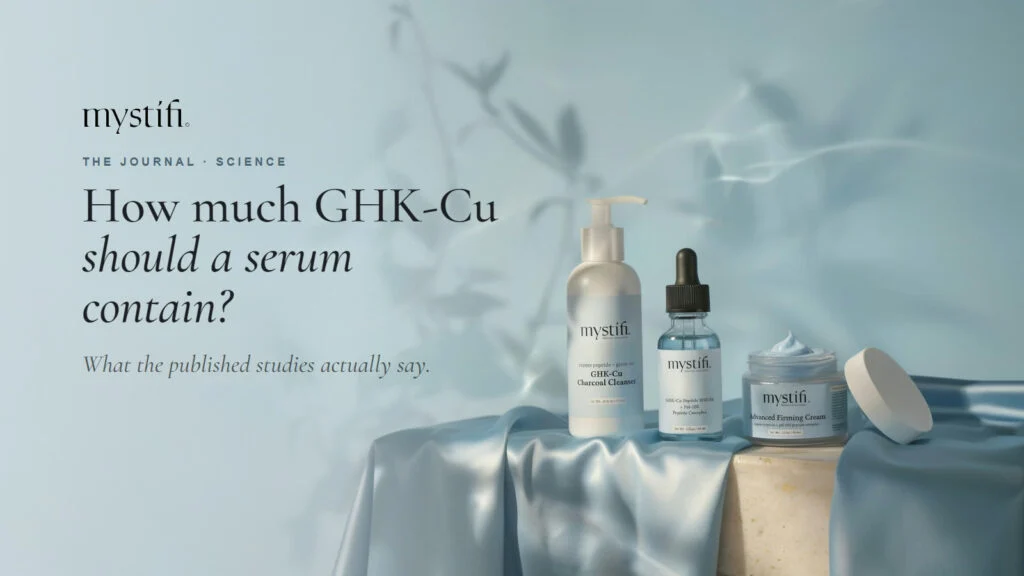
Our serum lists Copper Tripeptide-1 at 1%, paired with Pal-150. We publish the number so you can compare it with anything else on your shelf.
We are not saying 1% is a proven ideal, because nobody has shown that. The studies above tested other formulas, and we have not yet run a study of our own. Everything we cite is on The studies, with links to the sources, so you can check our reading of them.
If you try it, use 3–4 drops on clean, dry skin, morning and night. Patch test first: a little behind the ear or on the inner arm, 24 hours. Not sure where a serum fits in your routine? The ritual quiz takes four questions.
Common questions
Is a higher percentage of GHK-Cu better?
Not as far as anyone has shown. We found no human study comparing one percentage against another, and the cell work suggests more does not always mean more.
What does Copper Tripeptide-1 mean on a label?
It is the ingredient-list name for GHK-Cu, a peptide made of glycine, histidine and lysine bound to copper.
How long should I use a GHK-Cu serum before judging it?
The published studies ran for 8 to 12 weeks of twice-daily use, so give it that long.
Can I use GHK-Cu with retinol or vitamin C?
Yes. Alternate nights with retinol, or use the serum in the morning. Avoid layering it directly with L-ascorbic acid or glycolic acid in the same routine.
Sources
- Pickart L., Margolina A. Regenerative and Protective Actions of the GHK-Cu Peptide in the Light of the New Gene Data. International Journal of Molecular Sciences, 2018.
- Pickart L., Vasquez-Soltero J.M., Margolina A. GHK Peptide as a Natural Modulator of Multiple Cellular Pathways in Skin Regeneration. BioMed Research International, 2015.
- Badenhorst T., Svirskis D., Merrilees M., Bolke L., Wu Z. Effects of GHK-Cu on MMP and TIMP Expression, Collagen and Elastin Production, and Facial Wrinkle Parameters. Journal of Aging Science, 2016.
- Hostynek J.J., Dreher F., Maibach H.I. Human skin retention and penetration of a copper tripeptide in vitro as function of skin layer towards anti-inflammatory therapy. Inflammation Research, 2010.
- 21 CFR 701.3, designation of ingredients on cosmetic labels.
These are published studies of the ingredient and of other brands’ formulas, not studies of Mystifi’s formula. This article is general information, not medical advice.